
 +36 20 510 1951
  prothermo@prothermo.hu
 If a steel is harder than required, it must be annealed to restore machinability, cold-formability, etc. The higher hardness comes either from the work hardening of cold-formed products, or from a hot-forming or heat-treatment cooling rate that partially hardened the steel. Annealing is therefore needed for cold-worked products and especially for alloyed steels, in which even air cooling after hot forming can cause partial hardening.
Recrystallisation annealing
When cold-worked products are heated, undeformed grains develop at the expense of the deformed ones. The properties of the annealed product are determined by the resulting grain size, which in turn depends on the degree of cold work and on the temperature and duration of heating. The expected outcome can be read from the recrystallisation diagram. A fine-grained state is generally desirable, but for transformer sheets, for example, magnetic properties are better with coarser grains. In many cases only partial annealing is applied — i.e. recrystallisation is allowed only partially. This is how, for instance, half-hard wire is produced from spring-hard drawn wire. The success of annealing can be checked by hardness or tensile testing, supplemented by formability tests.
Full annealing
For hardened or partially hardened parts, restoring the equilibrium state can be useful if further machining or heat treatment is required. This is done by full annealing: the steel is heated to a temperature corresponding to the gamma (austenite) range, then slowly cooled in the furnace until the gamma-to-alpha transformation is complete, down to about 600 °C. The degree of softening depends on the cooling rate. Subsequent cooling can be done in air. Full annealing is typically used to improve the machinability of alloyed hot-worked products. Success is verified by checking the prescribed Brinell hardness.
Sub-critical annealing (below 700 °C)
Finished but unsuccessfully heat-treated parts — e.g. quenched-and-tempered components — must be annealed before re-heat-treating. With full annealing, the gamma-to-alpha transformation takes place, which can cause dimensional change or distortion. The high temperature can also lead to surface scaling and decarburisation. To avoid these, sub-critical annealing is carried out at a high temperature that does not yet cause austenitising, with a longer hold. Softening occurs during the hold as the hardened or partially hardened structure shifts toward equilibrium. This process is obviously more expensive than full annealing.
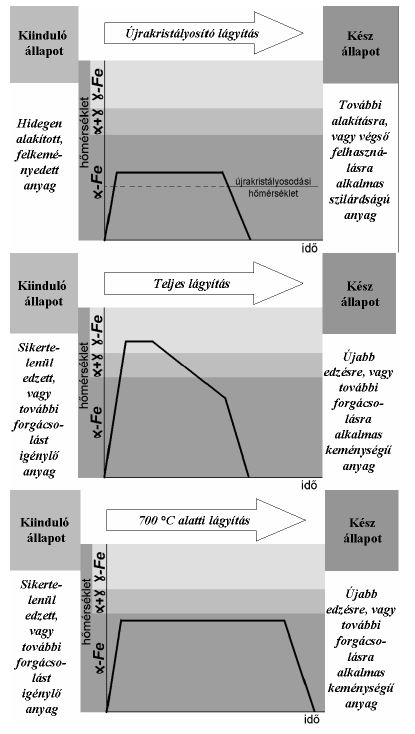
Source: Basics of the heat treatment of steels (Budapest Polytechnic, Bánki Donát Faculty of Mechanical Engineering, teaching material, 2004)